The British Artist Mary Linwood Used Sewn Thread to Create Her Fiber Art This Process Is Called
Crewel embroidery, or crewelwork, is a type of surface embroidery using wool. A wide diverseness of dissimilar embroidery stitches are used to follow a blueprint outline practical to the fabric. The technique is at least a one thousand years old.[ citation needed ]
Crewel embroidery is non identified with particular styles of designs, but rather is embroidery with the apply of this wool thread.[1] : 102 Modern crewel wool is a fine, 2-ply or one-ply yarn available in many different colours. Crewel embroidery is often associated with England in the 17th and 18th centuries, and from England was carried to the American colonies. It was especially pop in New England. The stitches and designs used in America were simpler and more economical with the scarce crewel wool. The Deerfield Guild of Blue and White Needlework (1896–1926) revived interest in crewel embroidery in the United States.
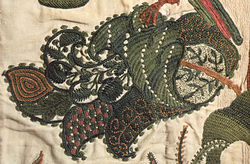
Description of the technique [edit]
The crewel technique is not a counted-thread embroidery (similar canvas piece of work), but a style of free embroidery. Crewelwork had its heyday in Great britain in the 17th century, but has come up in and out of fashion several times since and so.[2] Traditionally, crewel embroidery is done on tightly woven linen twill, though more recently, other fabrics similar Matka silk, cotton velvet, rayon velvet, silk organza, internet fabric and also jute have been used. A firm fabric is required to support the weight of the stitching, which is done with crewel wool. This blazon of wool has a long staple; information technology is fine and can be strongly twisted. Information technology is best to employ a crewel needle to execute the stitches every bit a needle with a wide body, large heart and a sharp point is required.
The outlines of the blueprint to be worked are ofttimes screen printed onto the fabric or can exist transferred to manifestly material using modern transfer pens containing water-soluble ink or air-soluble ink, using a lightbox and a permanent pen, or iron-on designs applied using transfer sheets. The old-fashioned "pinprick and chalk" or "prick and pounce" methods also piece of work well. The prick and pounce method involves transferring the design outlines – printed on newspaper – past pricking the outline with a needle to produce perforations along the lines. Powdered chalk or pounce cloth is then forced through the holes onto the cloth using a felt pad or stipple brush in club to replicate the design on the material.[iii] : 9–10
Designs range from the traditional to more contemporary patterns. Traditional design styles are often referred to as Jacobean embroidery featuring highly stylized floral and creature designs with flowing vines and leaves.[iv]
Many dissimilar embroidery stitches are used in crewelwork to create a textured and colourful effect. Unlike silk or cotton embroidery threads, crewel wool is thicker and creates a raised, dimensional feel to the work. Some of the techniques and stitches include:
- Outlining stitches such every bit stem stitch, chain stitch and carve up stitch
- Satin stitches to create apartment, filled areas within a blueprint[five]
- Couched stitches, where one thread is laid on the surface of the fabric and another thread is used to tie it down. Couching is often used to create a trellis outcome within an expanse of the design.
- Seed stitches, applied randomly in an area to requite a lightly shaded issue
- French knots are commonly used in floral and fruit motifs for boosted texture
- Laid and couched work
- Long and short "soft shading"[three]
In the past, crewel embroidery was used on elaborate and expensive bed hangings and curtains. Now it is most often used to decorate cushions, curtains, clothing and wall hangings. Recently several other items, such every bit lamp shades and handbags have been added.
Unlike sheet work, crewel embroidery requires the use of an embroidery hoop or frame on which the material is stretched taut and secured prior to stitching. This ensures an fifty-fifty amount of tension in the stitches, so that designs do not become distorted. Depending on the size of the finished piece, crewelwork is generally executed with a small-scale portable hoop up to big free continuing frames (as well known equally slates).
Etymology [edit]
The origin of the word crewel is unknown only is idea to come from an ancient discussion describing the coil in the staple, the unmarried pilus of the wool.[half dozen] The discussion crewel in the 1700s meant worsted, a wool yarn with twist, and thus crewel embroidery was non identified with detail styles of designs, but rather was embroidery with the use of this wool thread.[ane] : 102
History of crewelwork [edit]
The earliest surviving example of crewelwork is The Bayeux Tapestry, which is not actually a tapestry at all. This story of the Norman Conquest was embroidered on linen fabric with worsted wool.[seven] The creators of the Bayeux Tapestry used laid stitches for the people and the scenery, couched stitches to provide outlines, and stem sew together for detail and lettering. The worsted wool used for the embroidery may take come from the Norfolk village of Worstead.[7] There are few other early on crewel embroideries known. The Jamtlands Lans Museum in Sweden has three related items, the Overhogdals tapestries, from the 11th -twelfth centuries that testify people, animals, and other natural and man-built items. As of 2019, the main theory is that these works depict the downfall of the world, the Ragnarok.[8]
England [edit]
Wool from Worstead in Norfolk was manufactured for weaving purposes, merely also started to be used for embroidering small designs using a limited number of stitches, such as stem and seeding. These were initially often executed in a single color. Nonetheless, the color and design range expanded, and embroidery using this crewel wool began to be used in larger projects and designs, such every bit bed hangings.[seven] : 32
Rich embroidery had been used extensively in ecclesiastical vestments and altar drapings, merely after the Protestant Reformation, the emphasis moved to embroidery, including crewel piece of work, for use in homes and other secular settings.[7] : 32
Elizabethan Period [edit]
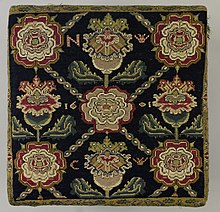
Embroidered cushion cover, 1601, British (Metropolitan Museum of Art)
Embroidery for household furnishings during the Elizabethan era was frequently worked using silk and wool on canvas or linen sheet. Garment embroidery more than ofttimes used silk or silk and silver threads. Many different stitches were used for the embroidery, including "dorsum, basket, braid, pleated complect, brick, buttonhole, chain, coral, cantankerous, long-armed cross, French knot, herringbone, link, long and short, running, double running, satin, seed, split up, stem, tent as well every bit laid work and couching."[9] : 16
Motifs frequently used in crewel embroidery of the period included coiling stems, branches, and discrete blossom designs.[9] : xvi Some embroideries from the Elizabethan menstruum used garden motifs for their design, equally gardens themselves were enjoying a heyday. These embroideries were worked in silk or wool (crewel), and were used in the home to brighten the surround. Embroidered wall hangings, table carpets, and various forms of bed-hangings might all sport embroidered images. The length of valences made them ideal for embroidery that told a story of a number of episodes.[ten] : 6–7
Stuart Period [edit]
Queen Mary II (co-reigned 1689–1694 with her hubby William II) and the women of her courtroom were known for the very fine needlework they produced. Using satin sew together with worsted wool, they created hangings and other objects showing images of fruits, birds, and beasts.[11] : 367 Their example spurred interest in crewel embroidery. Bed hangings and other effects were created, oft using bluish greens supplemented by brighter greens and browns. Occasionally, "a tedious pinkish red" would be the main color.[11] : 367
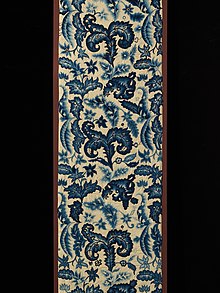
Crewel embroidery on bed drape panel, British, early on 18th century (Metropolitan Museum of Fine art)
Designs in the latter part of the 1600s fell primarily into three categories. I was individual sprays of flowers scattered over the fabric; the second, to exist found on narrow panels, involved flowering stems running the length of the panel with a floral motif betwixt them; and the third was a branching tree with stylized leaves, the Tree of Life. The tree sits on a mound, and at that place might be other small motifs of individuals or flora and fauna near the mound. Jacobean embroidery from the beginning quarter of the 17th century is known for this third category. Some experts believe that these patterns were derived from cotton fiber palampore from Masulipatam.[eleven] However, other experts stress the importance of multiple influences from dissimilar parts of the earth brought dorsum by English travelers, and evolving designs from earlier forms of embroidery.[12]
Flora and fauna found in the tree of life designs include the rose, noted for national and religious reasons, and 2 emblems of the Stuarts: the carnation and the caterpillar. Influence of exploration and trade are seen in plants in Jacobean that have recently become known to the English: the potato flower and the strawberry.[12] : xvi
During the time of William and Mary, Chinese motifs began to appear in crewel embroideries, such every bit pagodas, long-tailed birds, and Chinese people. Just equally Indian cottons may accept influenced designs with trees and exaggerated leaves, these Chinese elements may take been inspired by Persian silks and calico material.[11] : 368

Hanoverian period (c. 1740) crewelwork particular highlighting carnation
Jacobean embroidery designs enjoyed a resurgence in interest during the reign of Queen Anne (reigned 1702–1707). Patterns from the mid-1600s were copied, either exactly or with some alterations. While the tree motif is common to all, there is bear witness of gradual change in the designs that link them together.[12] : xii–xiii
United States [edit]
Colonial America [edit]
Early fabrics made in the Colonies tended to be plain in both weave and in color. Fabric was made from white and blackness wool, and indigo dye was used. With the use of these materials, the textile was grayness, chocolate-brown, or blue. Needlework was a way to enliven this fabric. and the earliest forms of needlework used were turkeywork and crewel embroidery.[13] : nine
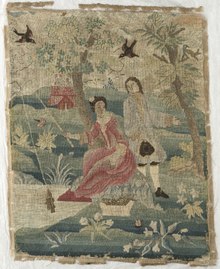
Line-fishing Lady crewelwork, 18th century, Boston (Cleveland Art Museum)
While early American crewelwork, and embroidery more generally, followed in the tradition of their English counterparts regarding fabric, designs, and yarn, there were some differences. Early American works tend to display a smaller range of individual stitches, smaller and less complicated designs, and the designs cover less of the background fabric.[14] : 82–3 A study of New England crewel embroidery found that the primary colors, blueish, carmine, and yellowish, were the near used. The stitches used most oftentimes were outline, seed, and economy, and the designs most frequently used showed plants.[13] : Abstract
Crewel embroidery was a pastime primarily in New England. In that location are some surviving examples from the mid Atlantic region, primarily New York and Pennsylvania, just these designs differed. Indeed, there were also stylistic differences within New England, with one region being the Massachusetts coast surface area centered on Boston, and another Connecticut.[1] : 104–105
Young women in New England in the 1700s were expected to become proficient at needlework. Day and boarding schools that taught different types of needlework existed, every bit evidenced by advertisements in colonial Boston newspapers.[15] : 77 They would embroider items both utilitarian, such as bed-hangings, curtains, dress, and bed linens, and ornamental, such as wall hangings.[16] : 26 In the early colonial period, the master bed was often located in the parlor, and thus on public brandish. Crewel bed-hangings provided both decoration and comfort, while serving equally a status symbol.[14] : 68 Women would also create smaller items busy with crewel piece of work, such as the detached pockets that were worn tied around one's waist and envelope bags carried past men and women that were popular in the second half of the 1700s.[17] : 113–115
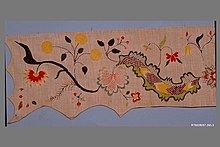
Item of linen valence ca. 1760-1770 embroidered with crewel wool, American
Many of the embroidery patterns they worked from included mutual motifs: trees, birds, flowers, groups of figures or animals. This indicates that these patterns may have been variations of a small number of originals.[xv] : 77 Landscape patterns with figures were more realistic in the 18th century than they were in the 17th century, and seldom involved scenes from the Bible, equally had earlier patterns.[16] : 26 Many of the New England embroidery designs in the 1700s included rounded and curving elements.[15] : 78
Patterns for crewel designs were obtained in a number of ways. Patterns in both England and New England were frequently derived from elements taken from engravings of English and French artists. These elements, oft figures or groups of figures, would be taken from diverse works and combined in different ways.[sixteen] : 26 In colonial New England, women used blueprint books or sketches in magazines (such as The Ladies' Magazine) that were obtained from England. Design books of other types, such equally gardens and furniture, were too used. Custom stamped fabric could be found in larger cities at times, as could custom-drawn sketches. Women may also have used designs from printed cloth for their crewel work.[13] : ten–eleven
From surviving Colonial crewelwork and written references such equally letters, information technology is known that near projects were embroidered on linen. Notwithstanding, the preferred groundwork fabrics were fustian (a twill cloth that generally had a linen warp with a cotton weft, though may have been all cotton) or dimity (which has fine vertical ribs and resembles fine corduroy).[18]
The range of wool colors that needleworkers in colonial New England could telephone call upon were rather limited. Many New England households grew indigo, which allowed wool to exist dyed in various shades of blue. Other natural materials, used with or without mordants, used to dye wool included: butternut shells (spring light-green); hemlock bawl (reddish tan); logwood (purple brown, blueish black, deep black imperial); broom sedge, wild reddish, sumac, and gold rod (yellow); onion skins (lemon and gilded yellow); and cochineal (regal, deep vino blood-red).[19] : xxx–31
Deerfield Society of Blue and White Needlework [edit]
There was a resurgence of interest in crewel embroidery in Deerfield, Massachusetts when two women, Margaret C. Whiting and Ellen Miller, founded the Deerfield Society of Blueish and White Needlework. This society was inspired by the crewel work of 18th-century women who had lived in and near Deerfield. Members of the Blue and White Society initially used the patterns and stitches from these before works that they had found in the boondocks museum.[20] Considering these new embroideries were not meant to replicate the earlier works, society artisans soon deviated from the earlier versions with new patterns and stitches, and even the use of linen, rather than wool, thread.[21] Miller and Whiting used vegetable dyes in order to create the colors of the wool threads, and handwoven linen fabric was bought for use as the background.[21] Members of this gild continued their stitching until 1926.[20]
Encounter also [edit]
- Jacobean embroidery
- Stumpwork
- Mary Linwood
- Crewel (novel)
References [edit]
- ^ a b c Rowe, Ann Pollard (1973). "Crewel Embroidered Bed Hangings in Quondam and New England". Boston Museum Bulletin. 71 (365–366): 101–163.
- ^ "Crewel Embroidery". Textile Inquiry Middle. TRC Leiden. Retrieved three May 2019.
- ^ a b Brown, Pauline. (1994). The encyclopedia of embroidery techniques. New York: Viking Studio Books. ISBN0-670-85568-5. OCLC 30858977.
- ^ Corbet, Mary (2019-01-25). "Hello, Crewel Globe! Tips to Help Y'all Blast This Revived Embroidery Style". Bluprint . Retrieved 2019-04-23 .
- ^ Goiser, Anna. "Basic Crewel Sew Vocabulary". Talliaferro . Retrieved 3 May 2019.
- ^ "The History of Crewel Embroidery". world wide web.suembroidery.com . Retrieved 2019-04-23 .
- ^ a b c d Majestic School of Needlework (London, England) (2018). The Purple School of Needlework book of embroidery: a guide to essential stitches, techniques and projects. Tunbridge Wells, Kent: Search Printing. p. 32. ISBN9781782216063. OCLC 1044858813.
- ^ "Överhogdal Tapestry: Amazingly Well-Preserved Aboriginal Textiles With Norse And Christian Motifs". Ancient Pages. 2019-04-26. Retrieved 2019-11-27 .
- ^ a b Davis, Mildred J. (1962). The fine art of crewel embroidery. [publisher non identified]. OCLC 5805445.
- ^ Brook, Thomasina. (1979). Embroidered gardens . New York: Viking Press. ISBN0-670-29260-5. OCLC 4947170.
- ^ a b c d Jourdain, One thousand. (1909). "Crewel-Work Hangings and Bed Article of furniture". The Burlington Magazine for Connoisseurs. 15 (78): 366–368 – via JSTOR.
- ^ a b c Fitzwilliam, Ada Wentworth. (1990). Jacobean embroidery : its forms and fillings including late Tudor. Hands, A. F. Morris. (1st pbk. ed.). London: B.T. Batsford. ISBN0-7134-6376-7. OCLC 27188169.
- ^ a b c Richards, Mary Lynne (1975). Crewel Design of Colonial New England and the Environmental Influences (M.A. Thesis). Michigan State University.
- ^ a b Swan, Susan Burrows (1976). A Winterthur guide to American needlework . Henry Francis du Pont Winterthur Museum. New York: Crown. ISBN0517521776. OCLC 2151073.
- ^ a b c Terrace, Lisa Cook (1964). "English and New England Embroidery". Bulletin of the Museum of Fine Arts. 62 (328): 65–80. JSTOR 4171406.
- ^ a b c Townsend, Gertrude (1941). "An Introduction to the Study of Eighteenth Century New England Embroidery". Bulletin of the Museum of Fine Arts. 39 (232): 19–26. JSTOR 4170793.
- ^ Weissman, Judith Reiter. (1994). Labors of dearest : America's textiles and needlework, 1650-1930. Lavitt, Wendy. New York: Wings Books. ISBN0-517-10136-Ten. OCLC 29315818.
- ^ Swan, Susan Burrows (1977). Plain & fancy: American women and their needlework, 1700-1850 . New York: Holt, Rinehart, and Winston. p. 105. ISBN9780030151217. OCLC 2818511.
- ^ Harbeson, Georgiana Brownish. American needlework: The history of decorative stitchery and embroidery from the late 16th to the 20th century. New York: Bonanza Books.
- ^ a b Howe, Margery Burnham. (1976). Deerfield embroidery. New York: Scribner. ISBN0-684-14377-i. OCLC 1341513.
- ^ a b The Needle arts : a social history of American needlework. Fourth dimension-Life Books. Alexandria, Va.: Time-Life Books. 1990. p. 104. ISBN0-8094-6841-7. OCLC 21482166.
{{cite book}}: CS1 maint: others (link)
External links [edit]
- Crewel work in TRC Needles
- How Crewel – Feature about the history and development of crewel work, with photographs
Source: https://en.wikipedia.org/wiki/Crewel_embroidery
0 Response to "The British Artist Mary Linwood Used Sewn Thread to Create Her Fiber Art This Process Is Called"
ارسال یک نظر